69 - What is the point of common coupling (PCC)?
4:11
• Point of Common Coupling (PCC): The Point of Common Coupling (PCC) is important to understand from both the utility and customer perspectives. It plays an important role as the point where the utility's network meets the customer's, and potentially their neighbors'. This is crucial for managing harmonics in the power system. • Harmonics Management: Harmonics, which are produced by loads and can affect neighboring systems. Utilities play a key role in preventing customers from producing harmonics that could disrupt the power system. • IEEE 519 Standard: We discuss the IEEE 519 standard, stressing that it should be applied to evaluate the installation containing nonlinear loads as a whole, rather than individual loads. This approach helps in understanding the overall system effect of harmonics. • Voltage and Current Distortion: We cover the requirements for not exceeding certain levels of total demand distortion, or TDD, from a current standpoint and avoiding voltage harmonic distortion. • Utility and Customer Concerns: There are mutual concerns of utilities and customers regarding harmonics. Utilities enforce regulations to prevent customers from affecting each other negatively, while customers are concerned about being affected by their neighbors' harmonics. Eaton’s Harmonic Frequently Asked Question’s FAQs collection of videos hosted by Dan Carnovale can help individuals from all different levels of education understand what harmonics are and explain many different solutions for mitigating harmonics on an electrical power system. Dan Carnovale P.E. has decades of experience in power quality and harmonics and is a recognized electrical industry expert in power quality and power systems. He is the creator and director of Eaton’s Power Systems Experience Centers (PSEC) in Pittsburgh PA and Houston TX. The PSECs provide visitors live demonstrations of hands-on power quality and harmonic situations and solutions can be seen first-hand in the Power Quality Lab. Visit Eaton’s harmonics knowledge website featuring harmonic solutions, harmonic calculators, access to white papers, and more: https://www.eaton.com/harmonics See our entire harmonics FAQs playlists: https://www.youtube.com/watch?v=U36ywxWHIy8&list=PL8XobqCtN9Z8maXVw0kYDLjmhBO275-bE&pp=gAQBiAQB For an educational overview of harmonics in person, visit one of Eaton’s Power Systems Experience Centers: http://eaton.com/experience #harmonics #powerquality #electricalengineering #electricalsafety #eatonexperience #experiencecenter
• Point of Common Coupling (PCC): The Point of Common Coupling (PCC) is important to understand from both the utility and customer perspectives. It plays an important role as the point where the utility's network meets the customer's, and potentially their neighbors'. This is crucial for managing harmonics in the power system. • Harmonics Management: Harmonics, which are produced by loads and can affect neighboring systems. Utilities play a key role in preventing customers from producing harmonics that could disrupt the power system. • IEEE 519 Standard: We discuss the IEEE 519 standard, stressing that it should be applied to evaluate the installation containing nonlinear loads as a whole, rather than individual loads. This approach helps in understanding the overall system effect of harmonics. • Voltage and Current Distortion: We cover the requirements for not exceeding certain levels of total demand distortion, or TDD, from a current standpoint and avoiding voltage harmonic distortion. • Utility and Customer Concerns: There are mutual concerns of utilities and customers regarding harmonics. Utilities enforce regulations to prevent customers from affecting each other negatively, while customers are concerned about being affected by their neighbors' harmonics. Eaton’s Harmonic Frequently Asked Question’s FAQs collection of videos hosted by Dan Carnovale can help individuals from all different levels of education understand what harmonics are and explain many different solutions for mitigating harmonics on an electrical power system. Dan Carnovale P.E. has decades of experience in power quality and harmonics and is a recognized electrical industry expert in power quality and power systems. He is the creator and director of Eaton’s Power Systems Experience Centers (PSEC) in Pittsburgh PA and Houston TX. The PSECs provide visitors live demonstrations of hands-on power quality and harmonic situations and solutions can be seen first-hand in the Power Quality Lab. Visit Eaton’s harmonics knowledge website featuring harmonic solutions, harmonic calculators, access to white papers, and more: https://www.eaton.com/harmonics See our entire harmonics FAQs playlists: https://www.youtube.com/watch?v=U36ywxWHIy8&list=PL8XobqCtN9Z8maXVw0kYDLjmhBO275-bE&pp=gAQBiAQB For an educational overview of harmonics in person, visit one of Eaton’s Power Systems Experience Centers: http://eaton.com/experience #harmonics #powerquality #electricalengineering #electricalsafety #eatonexperience #experiencecenter
Electrical - 100 latest videos Similar Videos
-
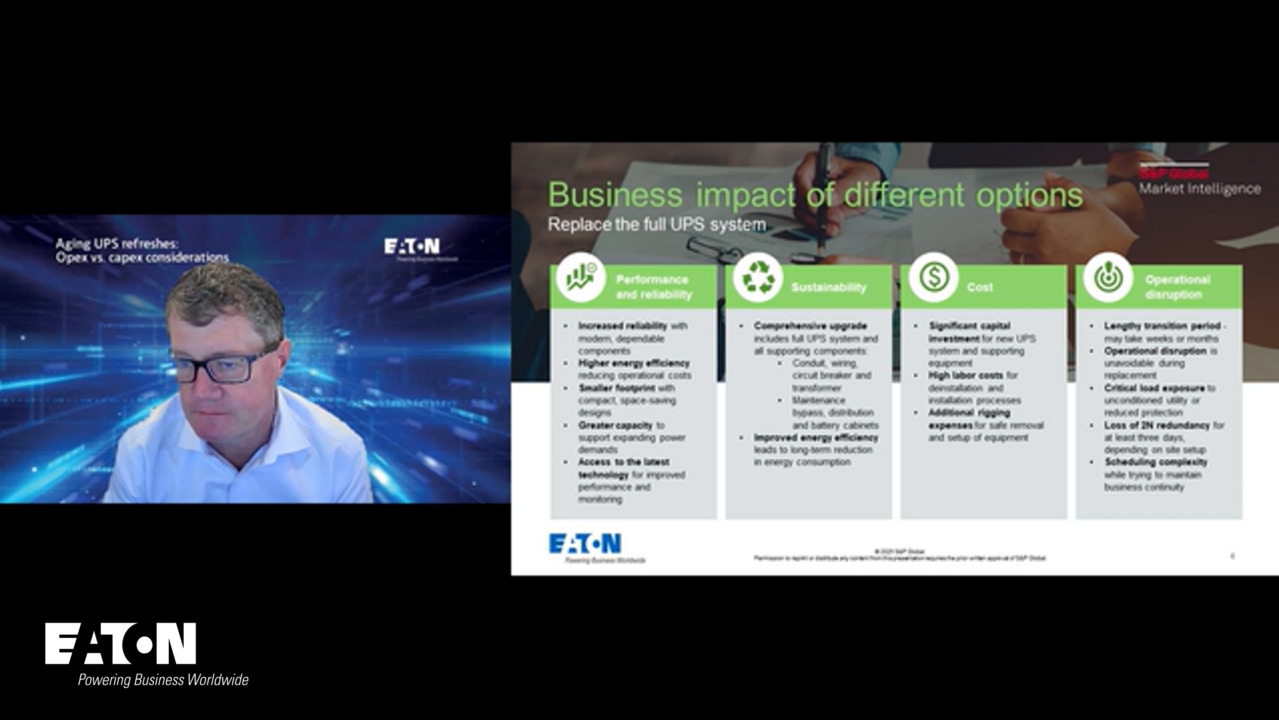
Aging UPS refreshes: Capex vs. opex considerations
32:41
Explore options for aging UPS systems as AI and energy demands rise. Learn cost, sustainability and performance tradeoffs from Eaton and industry experts.
-
Eaton Tech Day 2025 highlights
0:30
Eaton Tech Day is an electrical industry focused seminar that showcases the latest in power management, electrical safety, energy efficiency, grid resiliency, and energy transition.
-
Rack Enclosure Portfolio
1:17
Organize and optimize critical IT equipment with racks and enclosures from Eaton. Discover Eaton's full rack portfolio at Eaton.com/racks.